

New circular economy challenges: DVG De Vecchi’s commitment to environmental sustainability
New circular economy challenges: DVG De Vecchi’s commitment to environmental sustainability
From mono-material packaging management to metal recovery: how the Italian manufacturer of components and spare parts for professional coffee machines is actively contributing to Italy’s packaging recycling milestones.
Colnago, August 5th 2026
According to data from CONAI’s General Report, Italy reached a packaging recycling rate of 77.3%, while the total share of waste diverted from landfills nears 87%, ranking as one of the top-performing European countries in the circular economy.
The focus for the industrial sector is now on developing reusable, mono-material and easily recyclable packaging, in addition to using secondary raw materials, in compliance with the new European Packaging and Packaging Waste Regulation (PPWR).
Internal recycling and mono-material packaging: DVG De Vecchi’s operational choices
For a company like DVG De Vecchi ¬– which has been manufacturing components and spare parts for professional coffee machines for over 60 years, with a B2B catalog featuring more than 70,000 items for OEMs, distributors, roasters and technicians worldwide – these figures represent an industrial benchmark and an incentive to constantly streamline its workflows.
The very nature of the company’s activity, focused on manufacturing and supplying technical components and spare parts, imposes strict discipline on waste management and goods handling.
To address this commitment, the company’s approach is based on precise and measurable actions:
• Eliminating EPE foam: the company removed expanded polyethylene foam (EPE) from the packaging of its coffee tampers, replacing it with cardboard inserts. This change transforms the box into mono-material packaging, fully recyclable in the paper supply chain, which already surpassed a 92% recycling rate at national level.
• Packaging recycling: Packaging Recycling: With over 20 tons of paper and cardboard managed last year, DVG confirms its commitment to the environment. Our focus is on proper waste management: we collect the boxes and packaging materials received from suppliers and carefully prepare them to be sent to recycling supply chains, reducing the environmental impact associated with disposal.
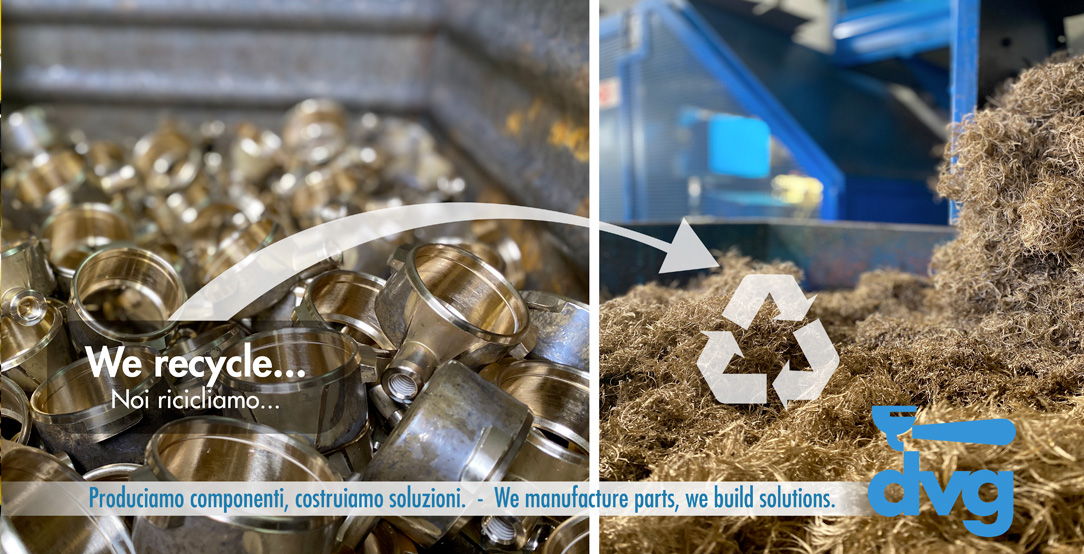
• Metal separation and recycling: steel, aluminum and brass scraps are accurately separated in the workshop, to enable their reintegration in the industrial supply chain as secondary raw materials.